

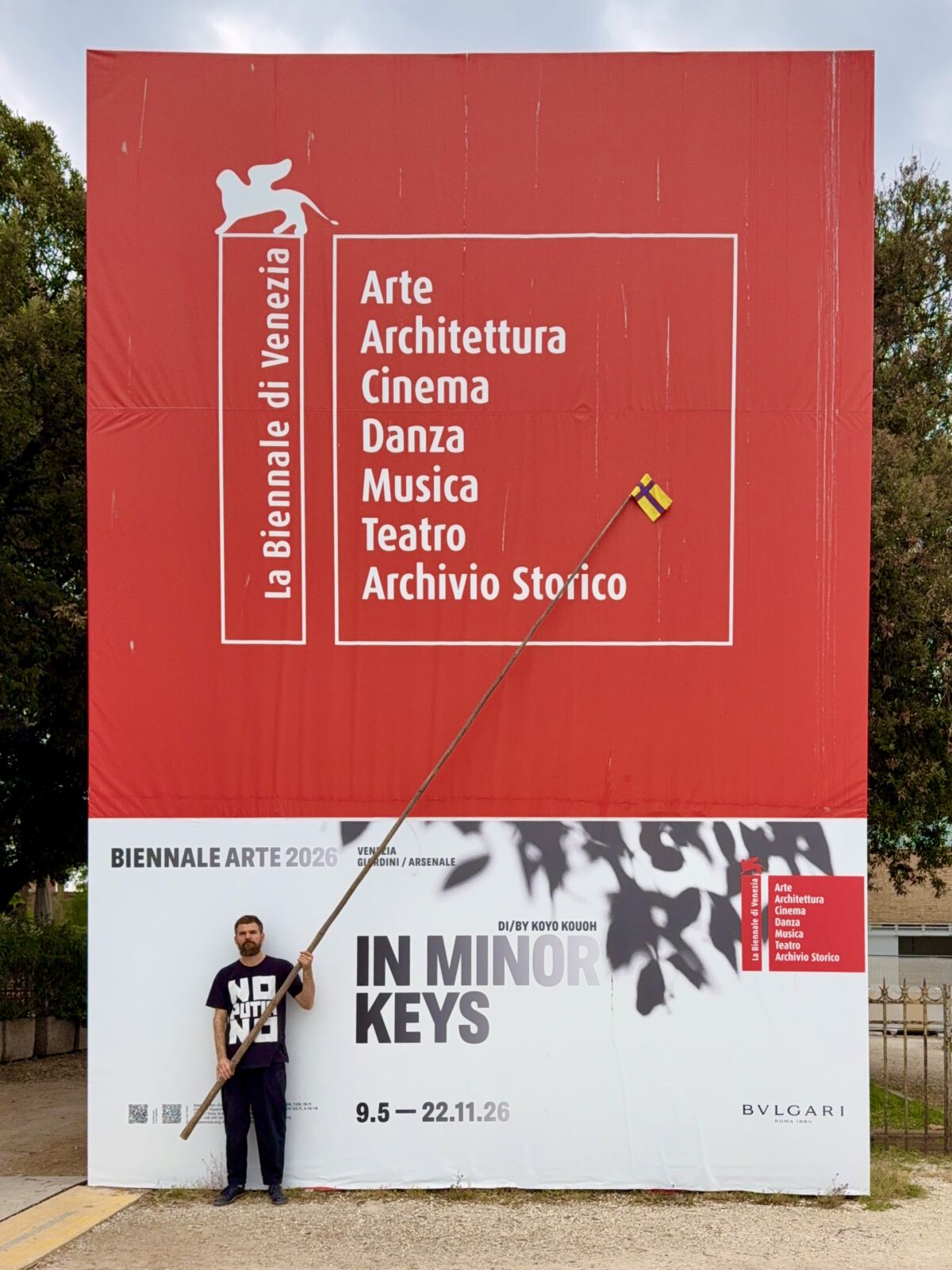
When the 2026 Venice Biennale opened its doors, one pavilion stood apart from the crowd of national representations — without a building, without a curator, without institutional support. Just one man, a few letters, and a message written in a history that must not be forgotten.
Helsinki-based artist Pavel Rotts created the Ingria Pavilion, a nomadic, travelling structure carrying the name of an erased homeland: Ingria.
How the Ingria Pavilion came to be
Rotts arrived in Venice as an assistant to sculptor Benjamin Orlow, who represents Finland at the Nordic Pavilion alongside artist Jenna Sutela. When he saw that Russia was returning to the Biennale for the first time since the 2022 invasion of Ukraine, he decided to respond. Not with a protest. Not with a banner. But with a gesture.
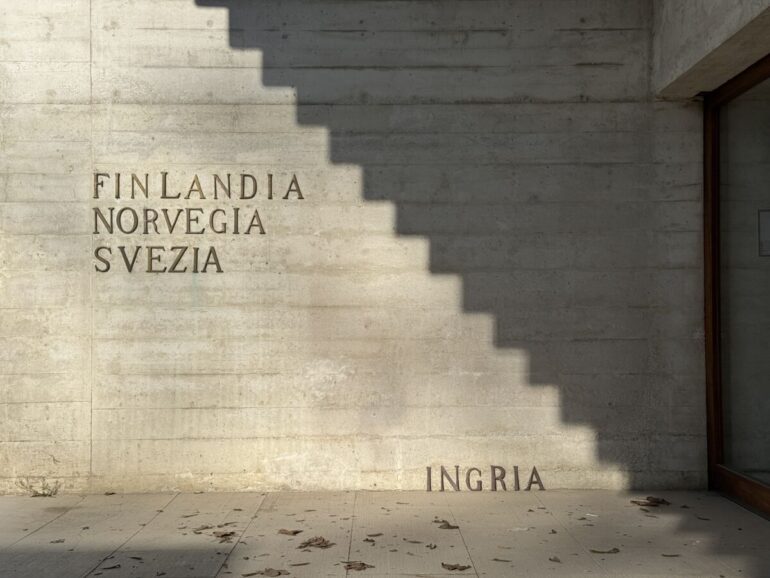
From letters found on the Nordic Pavilion — letters shared by Finland, Norway, and Sweden — he assembled a single word: INGRIA.
He was not the only one to respond. The punk feminist collective Pussy Riot flooded the space in front of the Russian Pavilion with pink smoke, Ukrainian flags, and chants of Blood is Russia’s art, alongside the Ukrainian feminist group FEMEN. Rotts did not chant. He arranged letters into a single word and let it walk through the same space.
The Nordic Pavilion’s curator and artists did not object to the temporary placement of the letters. Norwegian artist Tori Wrånes was particularly supportive of the project and even suggested that the letters be left in place. The letters travelled through the Giardini on opening day and continue their life afterwards — travelling back with Rotts to Helsinki, where they will be exhibited in various contexts.
Who is Pavel Rotts, and what is Ingria
To understand this gesture, one must understand the man behind it and the people whose name it carries.
Ingria (Inkeri) is a historical region along the Gulf of Finland, between present-day St. Petersburg and the Estonian border, the ancient homeland of Baltic-Finnic peoples. Through a series of ethnic cleansings, deportations, and evacuations in the 1930s and 1940s, the Ingrian Finnish population was largely expelled from the region. Finnish Ingria ceased to exist.
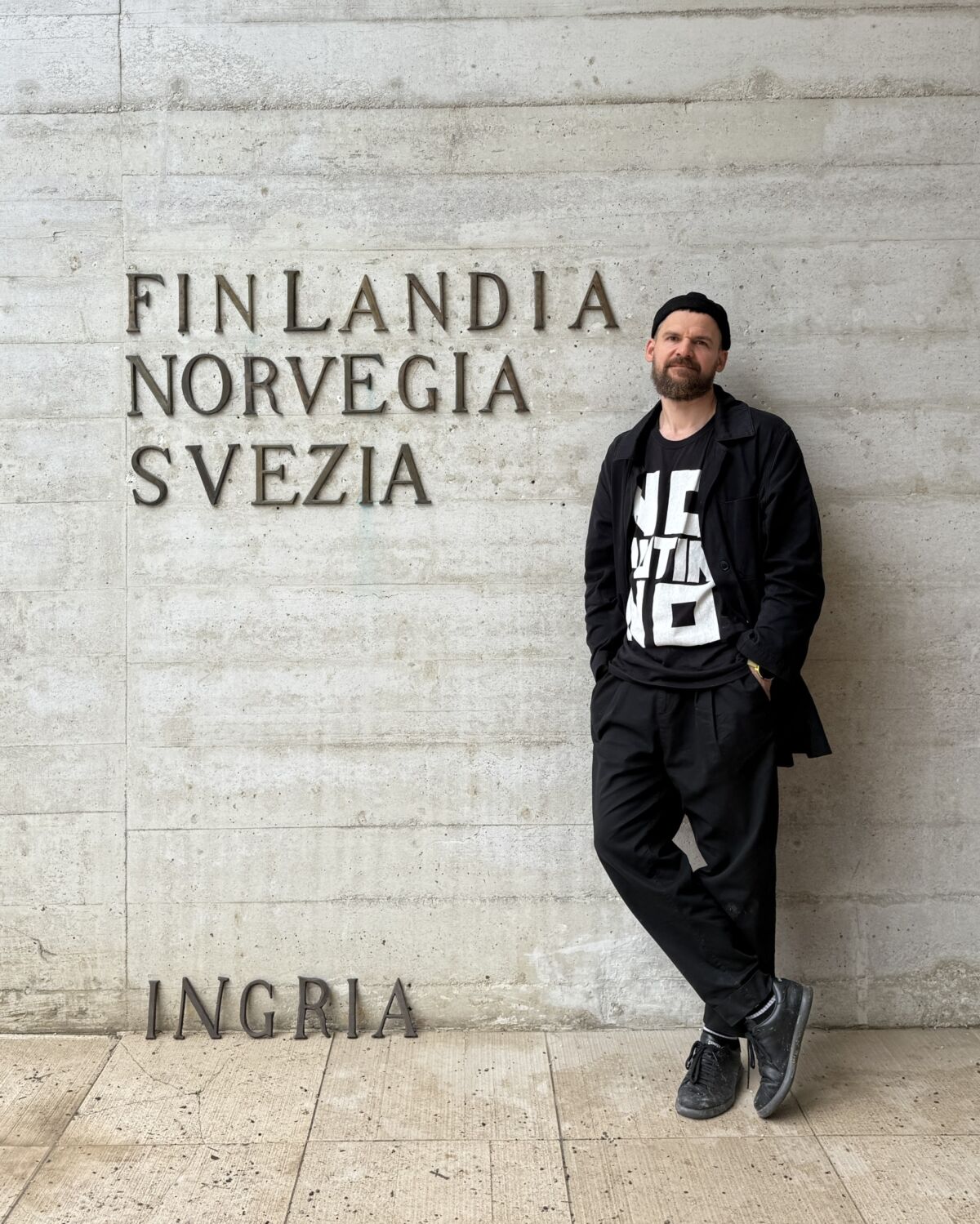
Rotts’s family experienced deportations, lived in forced resettlement areas in northern Russia, and was compelled to conceal its Ingrian identity. Rotts moved to Helsinki in 2015 under a repatriation programme initiated by President Mauno Koivisto. As a multidisciplinary artist working with installation, sculpture, performance, and research-based practices, he uses his Ingrian position as a starting point in his work. Origin is not merely a biographical footnote; it is a method.
The Sarajevo connection
On the way back from Venice, at Marco Polo Airport, we met Swiss artist Sasha Human, who connected us with Pavel Rotts. A message soon arrived, carrying a sentence that immediately established a bond: We really love Bosnia, and we visited Sarajevo. I was writing about the Sarajevo siege in my master’s thesis — it would be really great to talk about that with you.
We asked him to send us his master’s thesis. He did.
The thesis deals with the project Climbing a Memory, which began in September 2019 in Helsinki, when Rotts mapped traces of World War II bomb damage on the granite walls of the Finnish capital, cast the negative spaces left behind, and used them to create a series of artificial climbing holds. Climbing here is both method and metaphor — a way for the body to literally pass through a wound in the wall, to feel it and, perhaps, begin to heal it. The project later expanded to Narva, an Estonian border city devastated by Soviet bombings, where Rotts continued to explore war traces in urban space as material for memory.
In the thesis, Rotts also writes about Sarajevo. He travelled to Bosnia and Herzegovina to see the Sarajevo Roses for himself — traces of mortar shells in the asphalt, filled with red resin, which have become one of the most recognisable symbols of the four-year siege. In the thesis, he describes them as negative space that became a space of memory: craters the city chose not to fill in but to mark — filled with red resin, so they remain visible, so they remain present.
His two-week stay left a deep impression. In the thesis, Rotts notes a particular paradox he feels in the city: a Sarajevo that has lived a comparably normal life for over 25 years, yet whose walls are still riddled with bullet and shell holes, as if the war ended yesterday. Yet Sarajevans do not stop in front of these traces — they walk past them in the rhythm of everyday life, neither avoiding them nor hesitating.
The thesis records a deeper observation: the Sarajevo Roses are not only a memorial but also an act of animation, of breathing new life into traces of death. Craters transformed into flowers. Rotts cites researcher Dr. Mirjana Ristić, who describes the Sarajevo Roses as silent places of memory that allow passers-by to construct their own personal versions of memory and multiple narratives about the city’s history.
It was in Sarajevo that Rotts found the key to understanding his own method: not to describe trauma but to make it tangible. Not to erect a monument, but to leave a trace that can be touched — and from which one can continue.
He carries that same logic to Helsinki, to Narva, and finally to Venice: take an imprint of the absent, make something new from it, and keep walking.
Uređivačka transparentnost:
Ovaj članak je pripremljen u skladu sa Uređivačkim smjernicama FBL magazina. Naša misija je osigurati tačnost, integritet i estetsku vrijednost svake objavljene informacije. Primijetili ste grešku ili želite uputiti ispravku? Javite nam se ovdje.
Sadržaj je autorsko vlasništvo FBL Creative, Mannheim.