


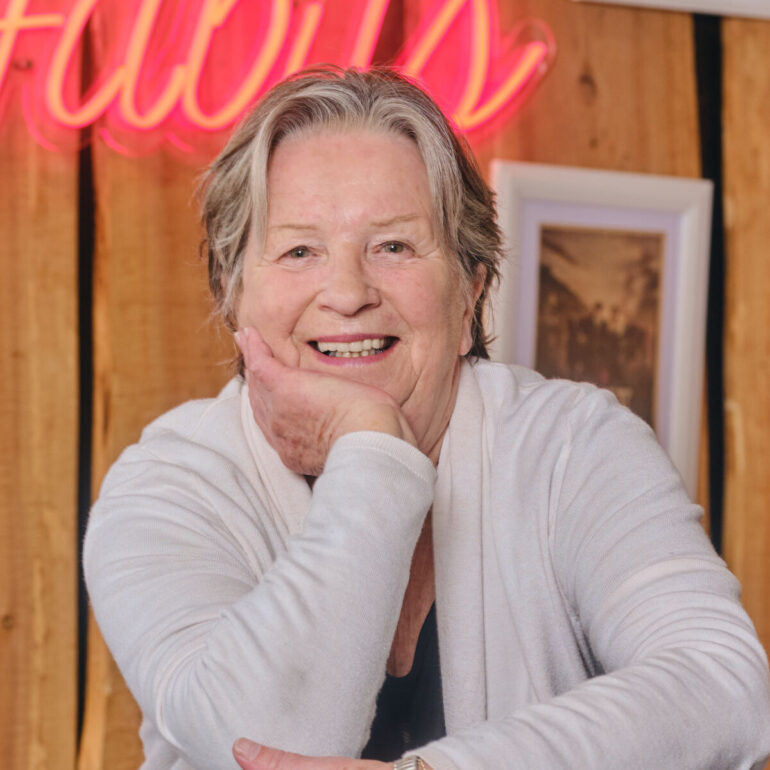
There is an old trick that car salespeople use to attract buyers — the phrase one lady owner, implying that the car was driven gently, slowly, never pushed to its limits. Sandy Myhre has spent her entire career dismantling exactly those assumptions.
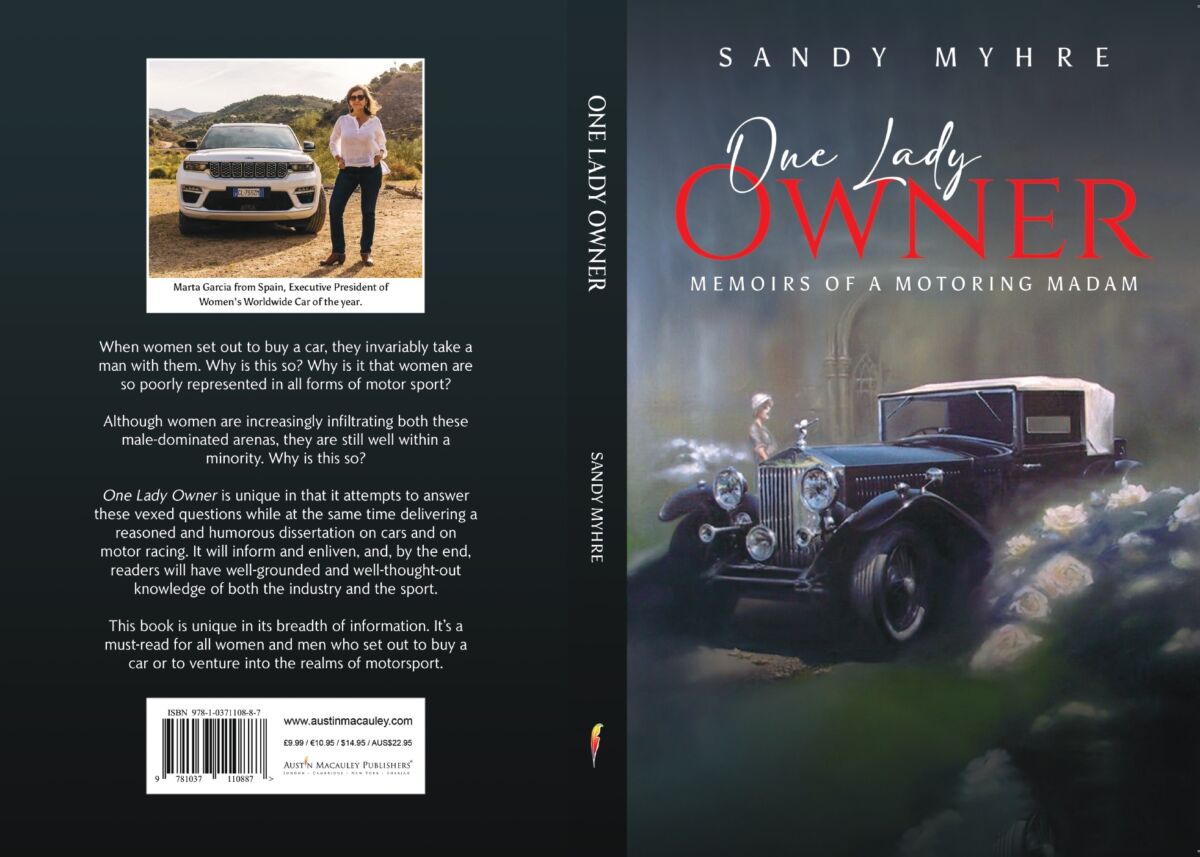
A New Zealand motoring journalist, founder of Women’s World Car of the Year, and one of the first women to have secured a permanent and unassailable place in the predominantly male world of automotive journalism, she has just published a memoir with a title that says it all: One Lady Owner: Memoirs of a Motoring Madam. The book is at once a sharp social testimony and a personal confession — a story about one woman, but also about all women; about cars, but also about what a car has always represented: freedom, status, and the right to drive wherever you want, however you want, without anyone explaining to you where the handbrake is.
The title, Sandy admits, was not an act of revenge, but it is multilayered. Motoring Madam is at once a tribute to the pioneers of women’s motoring, a self-irony, and a small provocation directed at an industry that has for years treated women as supporting characters in a story in which they were always the protagonists. The book opens and closes with WWCOTY — an award she launched almost single-handedly in 2009, in the midst of the global financial crisis, with an idea that industry lobbyists considered not only unnecessary but naive. Today, that award counts more than eighty jurors from around the world. Bosnia and Herzegovina has its own representative among them.
We spoke with Sandy about the book, about changes that came too slowly, about electromobility, and about one fundamental question to which neither she, nor the industry, nor motorsport yet has a real answer.
Sandy, the title One Lady Owner: Memoirs of a Motoring Madam does two things at once — it makes you laugh, and it draws blood. In the trade, one lady owner is a classic sales phrase implying the car was driven gently, carefully, never pushed to its limits. You spent your entire career doing the exact opposite — pushing cars to their limits, and pushing back against an industry that frequently didn’t want you there. Is this title an act of revenge, or something more subtle than that?
– I hadn’t thought of it like that! But Motoring Madam was a reference to the fact that we, as women motoring writers, are a bit like sex worker – you do something for a fee after being provided with something else, a car. Does that make sense? That’s where the Madam bit came in – and tongue in cheek saying it. Not everyone would get it, but I do feel a bit like a Madam presiding over a house of motoring.
You’ve noted that the book organically evolved into a deeper narrative about the parallel emancipation of women and the automobile. At what precise moment of writing did you realise that your personal journey was not just a memoir, but a mirror held up to a decades-long social revolution?
– About halfway through, I thought this isn’t about me. It’s about every woman in the world! That’s a bit ambitious but I felt as though I was writing for all women, no matter what their status or place in the world. I guess it did come from decades-long involvement. I am glad that it happened that way, sort of an evolution. And it goes back to the early pioneers of women drivers and racing drivers; what’s been said is a homage to them.
The book opens and closes with the Women’s World Car of the Year — a deliberate structural choice. But it raises a pointed question: is WWCOTY the crowning achievement of your career, or was everything that came before it — every road test, every article, every door you forced open — the long preparation for one idea that was simply waiting for the right moment?
– I think it was the right moment in time. No one had thought of it before, and I was there, sort of waiting for it to happen, or it happened by osmosis, I was the only one to put my hand up! But in retrospect, you are right, it was like every door being forced open, and it became the catalyst for so many opinions! I am proud of it, and Marta García has taken it from one level and cranked it up considerably. I am really proud of her achievements.
In the book, you examine a phenomenon many women know intimately: when they go to buy a car, they bring a man along — not necessarily because they want to, but because they fear they won’t be taken seriously without one. Where does the real problem lie — with women who have internalised a sense of inferiority, or with dealerships that have spent decades systematically manufacturing it?
– Women have internalised an inferiority because they haven’t been given the chance to do anything else. No one has said you can do it. And dealerships have spent decades manufacturing that because they don’t know anything else, it’s the way they’ve always done it, and, by God, it’s the way they will continue to do it. BUT! It is slowly, very slowly, changing, and WWCOTY has, in part, been responsible for some of that change.
Let’s run a small experiment. You walk into a showroom today, completely anonymously — no title, no credentials, no reputation. How long before the salesperson steers the conversation toward interior colour options and boot space, rather than safety architecture, energy recuperation systems, or handling dynamics? Has that actually happened to you — and how did you respond?
– The problem lies with dealerships or, more specifically, men! It isn’t just dealerships, it’s in motor racing too, where women feel intrinsically inferior and they struggle for recognition. When men (or dealerships or marketing managers or even bosses of motor companies) recognise women as customers or as drivers, it won’t change very much. Slowly, however, change is happening, and for one reason – they need to sell the product. The industry and the sport haven’t quite realised that small fact.
Today’s automotive advertising is saturated with imagery of independent women at the wheel. But is this a genuine cultural shift in the thinking of boardrooms and brand directors — or simply cold, precise commercial arithmetic, given that women now influence or make the majority of car-buying decisions?
– See above. I don’t see advertising being saturated with women. I still see it being saturated with men. Women do make the buying decision, but they are still a long way off from being recognised or even congratulated on that – sadly, it is still a man’s world.
Your research reaches back to the female designers, engineers, and pioneers of the late nineteenth century. Did you come away feeling that history has effectively written over women’s contributions to the automobile? And is there one specific female innovator you uncovered whose name, by any measure of fairness, should be as well known as Karl Benz or Henry Ford — but isn’t?
– You are right, women have been written over. The industry stopped recognising women after World War II, especially in the USA, where they depicted women in bathing suits selling spark plugs. Yes, there is one woman I thought was brave, feisty, a leader in her field, and that was Hélène Delangle, known as The Bugatti Queen. She raced successfully in Europe and the USA, and she arranged her own sponsorship; she promoted herself very well and was certainly ahead of her time. She was born in 1900 and died in 1984. And, Mary Barra. You have to acknowledge that she certainly has made the grade in the motor industry, and what she has achieved is admirable.
You made a deliberate choice to leave out technical engine breakdowns and driving manuals. Was this an intellectual statement — a proof of concept that automotive writing can be deeply analytical, socially urgent, and genuinely entertaining without ever needing to submit to the traditional gatekeeping of the boys’ club?
– Not really an intellectual statement. When I first started off, one man said I couldn’t write about cars because I wasn’t a mechanic. I pointed out that all the men in the NZ Motoring Writers’ Guild weren’t mechanics either!
Your book balances serious social analysis with sharp humour, so I’ll ask this directly: what is the real handbrake for women in motorsport today? If we set aside the surface symptoms — the lack of visible role models, the sponsorship gaps — what is the structural, root-cause reason that still keeps girls away from karting and single-seaters? And whose responsibility is it to fix it?
– I honestly don’t know the answer to that. I think women themselves have to get out of the supportive role (to men) and show the world they can drive well and competently. But most don’t get encouraged to do that – by men mostly. So again, do we have to change men? I think we do, and how we go about that, I am not sure, even after all this time.
One Lady Owner engages seriously with electrification, alternative fuels, and sustainable materials. Many automotive traditionalists claim, loudly, that the EV era is killing the soul of the car. Can a true Motoring Madam find genuine passion in silent acceleration and instant torque — or do you privately miss the smell of petrol and the particular violence of a V8 at full throttle?
– I don’t really miss the smell of petrol! And I am sure EVs drive very well, but they just aren’t exciting! There’s something to be said for a decent amount of acceleration and a bit of noise!
It is often said that what we drive is an extension of who we are. After a lifetime of analysing cars and the people who choose them, what does a person’s vehicle tell you about their character — before they’ve said a single word?
– I think it depends on one’s budget. I drive a really ordinary Nissan Tiida because that’s what I can afford, and it suits my lifestyle now. When I see a Ferrari or a Lamborghini, it is usually in the hands of a male, 30-40 years old, and showing off! That says more about him than me. It’s not often I see women in a top-notch sports car parading along the waterfront. Or dragging off a car next to it on the motorway.
Founding WWCOTY in 2009, in the middle of a global recession and with an industry that greeted the idea with open scepticism, was, by most reasonable measures, a form of madness. You now have over eighty jurors worldwide. Do you remember the precise moment — or the specific reaction from a manufacturer — when you thought: That’s it. They can no longer ignore us. We’ve won!
– An interesting comment. I think the first-ever press conference in London was a defining moment. I thought we got quite a lot of publicity for that event, considering it was a first. But still, many years after that, we did struggle for recognition in some quarters, and it’s taken a while to be taken seriously. But I really do believe that now we are, thanks in large part to Marta’s hard work, and getting more and more women journalists on board. It simply can’t be ignored.
WWCOTY has never chosen a woman’s car — because cars don’t have a gender. And yet automotive marketing continues to insist that men and women buy cars for fundamentally different reasons. Was that division ever real, or has it always been a commercially convenient myth — one that simply makes segmentation easier to sell internally?
– They say men and women buy cars differently, but where is the proof? And the marketing to accompany it? The motor industry is still stuck in the same old ways of doing things. If the industry could market to women the way they say women buy a car, that would be great! But it hasn’t happened yet.
Writing a book that is simultaneously sharp social criticism and personal memoir is precarious territory. How did you avoid the twin traps of self-pity and self-glorification? And how difficult was it to be truly ruthless — journalistically ruthless — about your own life?
– All I set out to do was tell a story, and I hope I’ve done that and managed to tell it well; that’s what I care about. I hope it isn’t full of self-pit or self-glorification. I just told a story – and I hope the words speak, literally, for themselves.
You launched a global movement when the automotive industry was analogue, predictable, and largely closed. Today, the landscape is autonomous vehicles, AI co-pilots, and screens replacing the entire tactile experience of driving. Do you still recognise the industry you fell in love with? And if you were starting your career right now, would this still be a world you’d choose?
– That’s another interesting question. I think it’s still the early days of AI, so the jury is out on that one, although changing rapidly. I think I was lucky to be born in the right era; we had large press conferences, and whoever was running them would say ‘Gentlemen and Sandy’ because I was the only female in the room for many years. As time went on, that changed, and women started infiltrating the industry – and I am so grateful that I was a part of that change, again, being born in the right era. Today? I think it’s competitive, but women have so much more opportunity to write, to podcast, to televise, and speak about cars and the industry. I am slightly in awe of the opportunity provided today; on the other hand, I am glad I don’t have to compete in the current environment.
Uređivačka transparentnost:
Ovaj članak je pripremljen u skladu sa Uređivačkim smjernicama FBL magazina. Naša misija je osigurati tačnost, integritet i estetsku vrijednost svake objavljene informacije. Primijetili ste grešku ili želite uputiti ispravku? Javite nam se ovdje.
Sadržaj je autorsko vlasništvo FBL Creative, Mannheim.