

While the artist Mladen Bundalo explores the complex geometry of belonging and the transformation of identity for those who have left Bosnia and Herzegovina through his Domus Diasporica project at the national pavilion of the 2026 Venice Biennale, entirely different biographies are being written at Sarajevo addresses.
As relentless statistics continue to count suitcases packed for departure, a quiet, creative counter-migration pulses beneath the public radar. In the following sections, we bring you the stories of two young digital nomads and creatives. They have chosen to maintain the privacy of their full identities, letting their choices speak louder than their surnames.
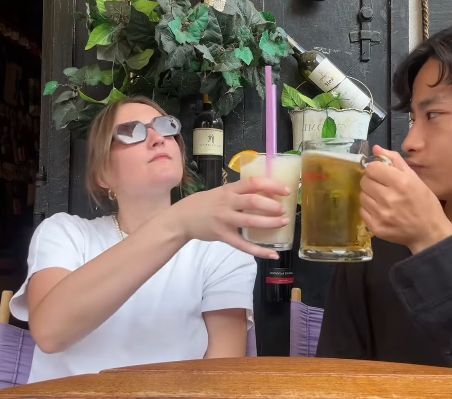
One is @peanutbutterovic, a bilingual creative who swapped Parisian boulevards for the beauty of Sarajevo’s streets in search of that part of herself that was always ours. She has channeled her quest for identity into a unique project—an illustrated book-quiz titled Say It Like A Bosnian, set for release on April 2nd. Through a collaboration with @taytu_art, she explores the richness and specific humor of our language through the eyes of a half-foreigner.
The other is @laamidar, an artist of movement and communication who arrived in Bosnia and Herzegovina from distant Asia via Europe. Here, he found a raw, authentic beauty that the modern world is slowly losing.
Through their experiences, we discover what this country looks like through the eyes of those who didn’t have to come, but chose to build their Domus right here.
I’m curious, what do you usually do, and what kind of work do you do online while traveling?
@peanutbutterovic_My background is a mix of politics and communication. When I first moved to Sarajevo, I’d just finished my studies and an internship at an ad agency, where we coordinated campaigns for the European Commission. And before that, I spent a year working in politics. But I wanted to move into the private sector, so I went freelance and helped different companies with social media online. Now I am based in Sarajevo full-time, and I work for Bosnian companies!
@laamidar_My background is in communications, brand-focused storytelling, and social media. Before that, I also worked as a professional ballet/contemporary dancer for 4 years, so I think both of those worlds shaped how I see places and people. A big part of my professional work has been in international organizations, including within the UN system, where I have worked in communications roles across different themes. What I enjoy most is that communication can be applied to so many important areas, whether that is human rights, Sustainability, or other global issues. Alongside that, I of course create content about BiH as I discover through my own perspective as an asian guy.
What attracted you to live specifically in Bosnia and Herzegovina?
@peanutbutterovic_So, as I said, I’m binational. My dad is Bosnian, but I grew up in France, speaking French, surrounded by French people. The older I got, the more curious I became about that other side of me. I started writing all my uni papers on topics I could connect to BiH somehow. Then one summer, during a gap year, I had three months free, so I used it as an excuse to do an internship in Sarajevo. And I just fell in love with the city.
@laamidar_At first, I only came to Bosnia and Herzegovina for a short stay. I was between jobs at the time and wanted to explore the Balkans more, especially because it still feels underrated compared to many other places in Europe. I have always been more drawn to places that feel raw, real, and less overexposed. The moment I arrived in Bosnia and Herzegovina, that is exactly what I felt. I was fascinated by the history, the people, and, of course, the food. I was also living in parts of Western Europe where the cost of living is very high, so I would be lying if I said affordability was not also part of the attraction. Over time, I started sharing my experiences online just naturally, and the response was much bigger than I expected. That made me realize there was real value in continuing to show Bosnia and Herzegovina through my eyes and in highlighting a country that deserves much more attention.
What does your typical daily routine look like in BiH?
@peanutbutterovic_Honestly, my daily life here is so much less monotonous than it was in Paris. I try to start with the gym (keyword: try). Then I work from home in the morning, take a walk or run errands at lunch, and head to the office or coworking space in the afternoon. After work is content creation mode, scripts, editing, side projects, the whole thing. Lately, I have been working on a book that is coming out very soon, so that has taken up a lot of my evenings.
@laamidar_My routine is honestly quite simple and relaxed. I am not a morning person, so I usually start my day around 10 a.m. I make coffee first, feed my three cats, clean up a bit, put on some music, and ease into the day. While I am having coffee, I usually check my emails and messages and focus first on my professional communications work. After that, I shift into content mode and look at what I have planned for the day. Since I try to post regularly about Bosnia and Herzegovina, I usually already know whether I am staying in or going out to film. Some days that means visiting a café or restaurant, some days it means exploring the city, and sometimes it means meeting collaborators or other creators. By the time I am back home, it is usually evening. Then I cook something, spend time with my cats, and relax. I often leave editing for the next day because I usually have content in the pipeline already.
Where do you like to work — coworking spaces, cafés, or from home?
@peanutbutterovic_All of them, honestly. I am the type of person who needs constant change, or I go a bit crazy. Last summer, when I started working for the Sarajevo Film Festival, I figured out that going to coffee shops really helped with creativity. Some days, I need to be home to work on scripts out loud. Some days I need to be outside. And some days you just need a proper desk and silence.
@laamidar_I prefer working from home. My home in Sarajevo feels very comfortable and personal, and I have created a space that feels peaceful and inspiring for me. With my three cats around, it also just feels more alive. I understand why many people enjoy coworking spaces or cafés, but for me, I work best from my own place.
What are the biggest advantages and challenges of living and working in BiH?
@peanutbutterovic_The biggest advantage for me is being a short drive away from basically every landscape you could want: forests, the seaside, and mountains. It’s perfect for a reset over a weekend. You can literally do a day trip to the seaside, which is crazy to me. For challenges, from what I’ve heard, visas are a real thing. But that’s not something I’ve had to deal with personally, so I won’t pretend I have.
@laamidar_One of the biggest challenges is finding work locally. That is not only difficult for foreigners but also for many Bosnian people, which is why the diaspora is so large. Building a network takes time, and opportunities do not always come quickly. On a more personal level, one challenge I experience as someone from Asia is access to familiar ingredients. There are no dedicated Asian grocery stores, so when I want certain products, I usually bring them back from Vienna. It is a small detail, but it really reminds you how different daily life can be depending on where you are from.
At the same time, there are many advantages. The cost of living is still relatively affordable compared to Western Europe, which allows more freedom and flexibility, although I am also aware that this may not feel the same for everyone locally. The nature is incredible, especially the rivers and the quality of water, which feels very fresh and pure. Another big advantage is how easy it is to communicate. Many people speak English, which makes everyday life much more accessible as a foreigner.
What advice would you give to someone considering coming to BiH as a digital nomad?
@peanutbutterovic_Honestly? Just come. I’ve seen so many people visit Bosnia for a week and then just keep coming back. So don’t overthink it. And I guess once you’re here, as long as you always carry cash with you, you’re gonna love it!
@laamidar_My biggest advice is to be patient and to come with an open mind. Whether you are staying for a short time or longer, Bosnia and Herzegovina is not a place you should try to experience through a rigid checklist. The best moments often happen when you leave room for spontaneity. Walk around without overplanning every detail. Let the city surprise you. In Sarajevo especially, some of the best experiences come from simply wandering, sitting somewhere for coffee, or starting a conversation. I would also say: do not misread the directness of local people. Sometimes people in the Balkans can seem very straightforward at first, but underneath that there is so much warmth and kindness. It just takes a little openness to feel it. I would also recommend learning a bit about the country’s history and culture before coming, because that helps you experience the place more respectfully and more deeply. In Sarajevo, I love spending time in the Old Town and just walking without a plan. Trebević is also beautiful, especially in warmer months. For food, one place I personally enjoy is Kibe Mahala, especially for a special occasion. And for coffee, honestly, almost anywhere in the Old Town is part of the experience. The key is not to rush. Bosnia and Herzegovina is a place where you feel best when you slow down enough to really take it in.
Uređivačka transparentnost:
Ovaj članak je pripremljen u skladu sa Uređivačkim smjernicama FBL magazina. Naša misija je osigurati tačnost, integritet i estetsku vrijednost svake objavljene informacije. Primijetili ste grešku ili želite uputiti ispravku? Javite nam se ovdje.
Sadržaj je autorsko vlasništvo FBL Creative, Mannheim.