

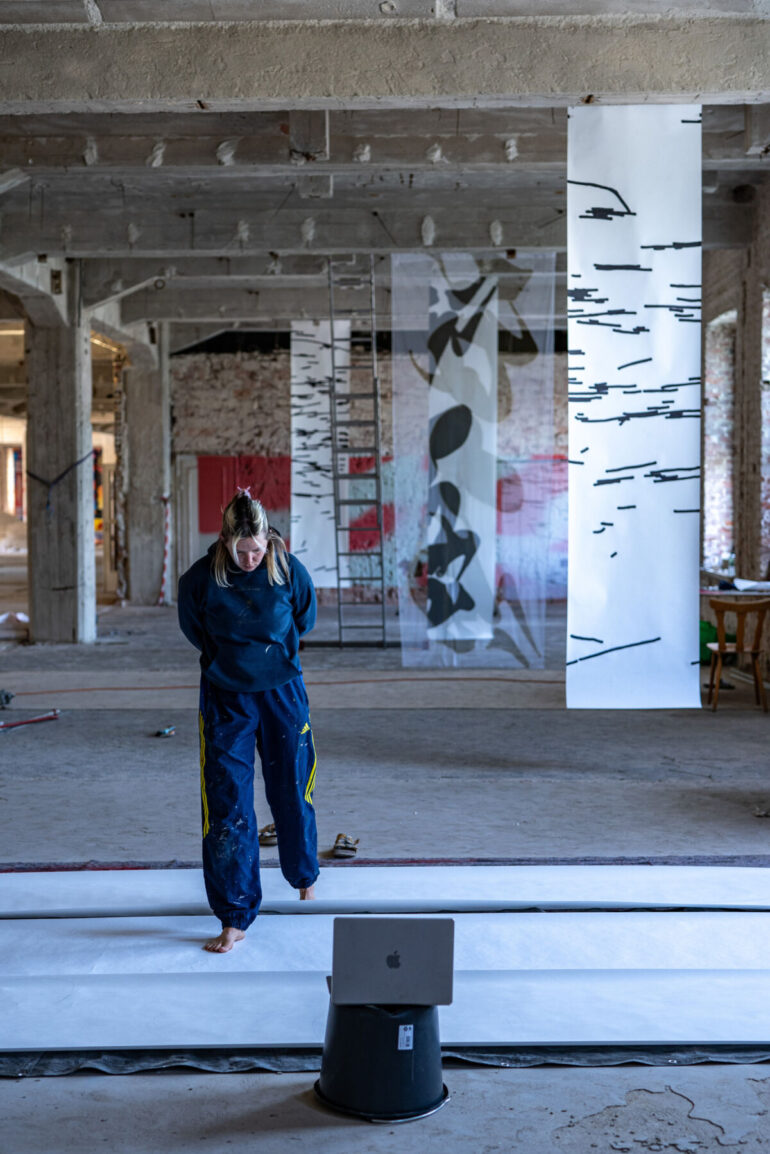
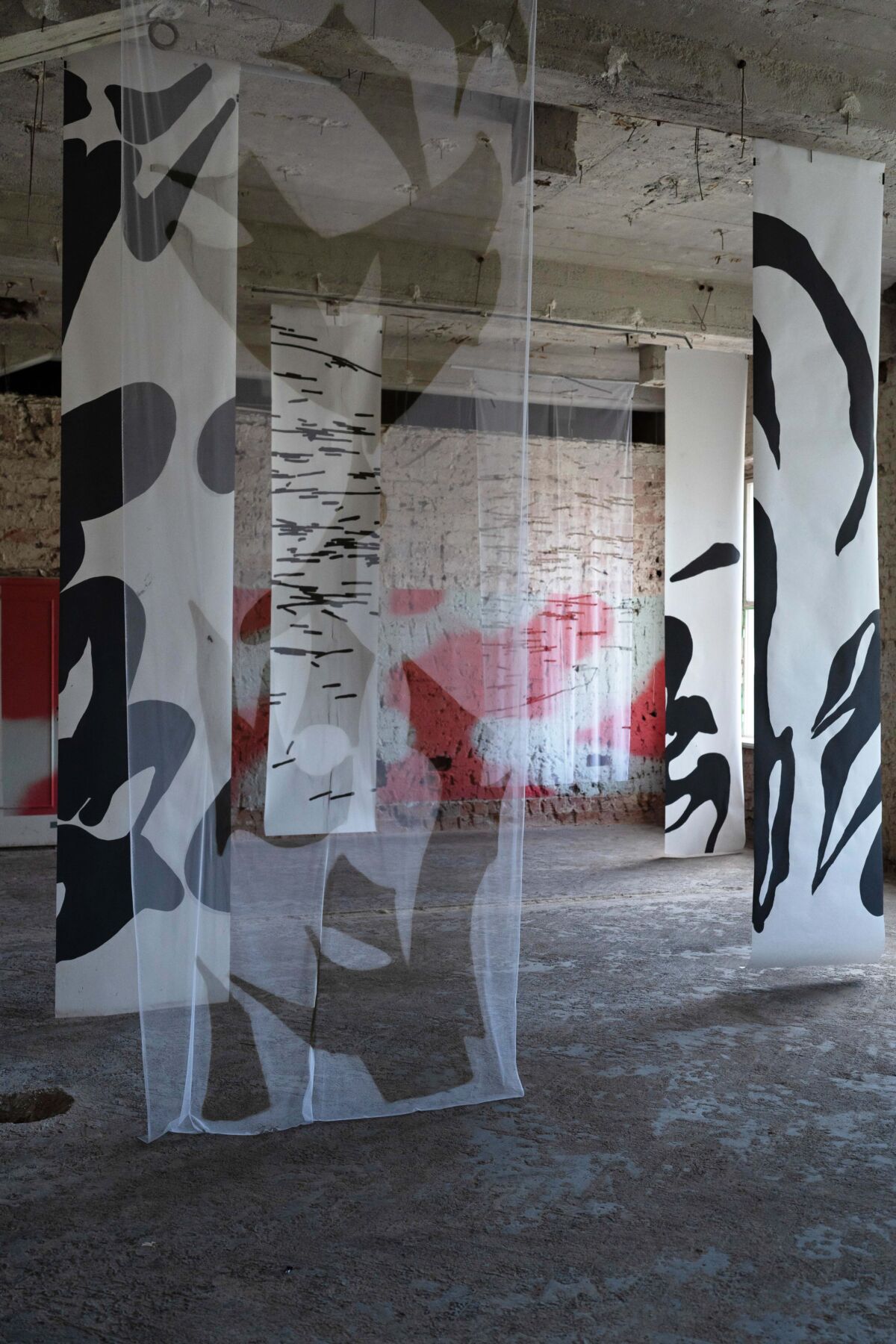
Luisa Keintzel Lumi is an artist who grew up surrounded by Berlin’s graffiti scene, yet her work often feels like its negative. Her murals, drawings, and textile pieces, characterized by a modest color palette, frequently evoke abstracted graffiti.
As a recipient of the Female Rising Star Award, Lumi will soon arrive in Sarajevo to paint a mural in the Hrasno neighborhood as part of the sixth edition of the FASADA Festival. Speaking with FBL magazine, Lumi shared insights into her origins, her artistic development, and the power of street art to empower women and unite communities.
You’re an academically trained artist who has been working in the field of urban art for about four years now. What made you move from the studio into public space?
– Urban art never really came from my studies. I started to paint independently alongside my studies. It came from a desire for freedom and working in large format. In uni, I found it harder to let loose and create while being unwatched, as well as because space was limited. In public space, many people work under aliases, which gives you a certain sense of anonymity, and also, it depends on where you work; you are not seen immediately, which I really enjoyed. You didn’t get judged, so instead you are becoming your own judge, which felt very authentic.

You once mentioned that you always struggled with school systems, and that this might be part of why you started painting in public. Can you tell us more about that connection — what did public space give you that the classroom didn’t?
– I never enjoyed being in a graded system. If I did too much, I was a nerd; if I did not enough, I was not passing. When I started to paint, I just created and developed in that way.
Your style is predominantly abstract, with fluid, organic shapes that often seem to reference anti-style graffiti. Was there a specific turning point in your stylistic development, or did it evolve more intuitively?
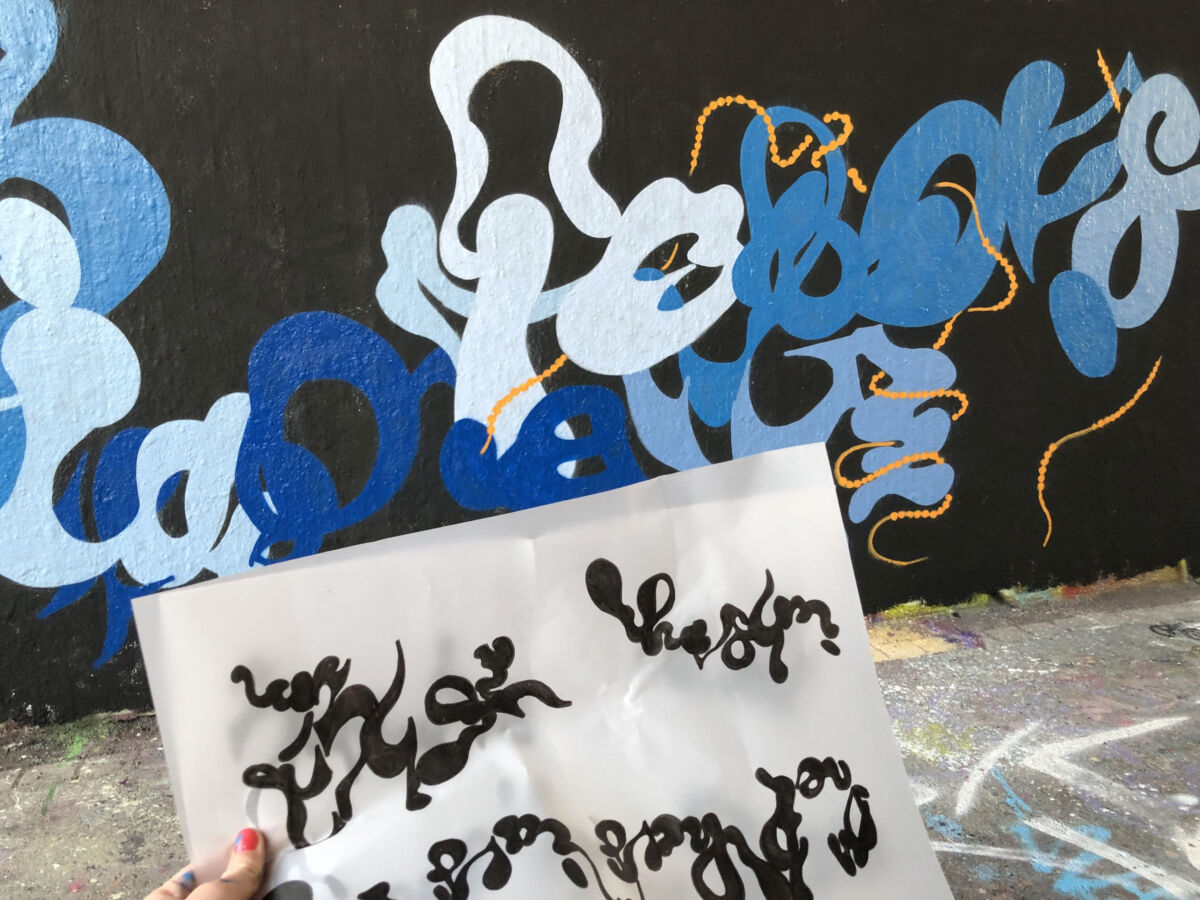
– When I started to paint in public, I connected freedom with it. After a while, I realised graffiti is connected to many rules you are supposed to stick to. It took away autonomy and even bored me. I started to paint letters, but at some point I realised this is not myself. I wanted to develop my own style that feels like myself. I abstracted letters so much that they were not readable anymore. A lot of the shapes I work with I find in public spaces, like scratches on the wall, buffs, reflections, and shadow games. I develop these further into writing systems and drawings. Additionally, I started to work more from my sketchbook, because I had always drawn a lot. This felt like something that genuinely came from me.
You’ve mentioned being heavily influenced by other mural artists and the graffiti community around you. Who or what specifically shaped the way you paint, and the way you understand urban art?
– I think the people I started to paint with, who opened up this world to me — so my closest environment — influenced me the most.
Since 2023, you’ve been part of the collective TIEV, working mainly on installations that connect art and architecture. How does working collectively change your process compared to painting on your own?
– We started to work together because we liked each other’s visual style. We bring those handcraft skills together in our work. Our collective work feels very natural and, most importantly, fun. Working together makes us feel very powerful — getting girls together to take up space is sometimes much easier than alone. I also feel powerful on my own, painting walls, but it gets another spice when women get together and create, especially in a field like urban art, which is still very male-dominated.
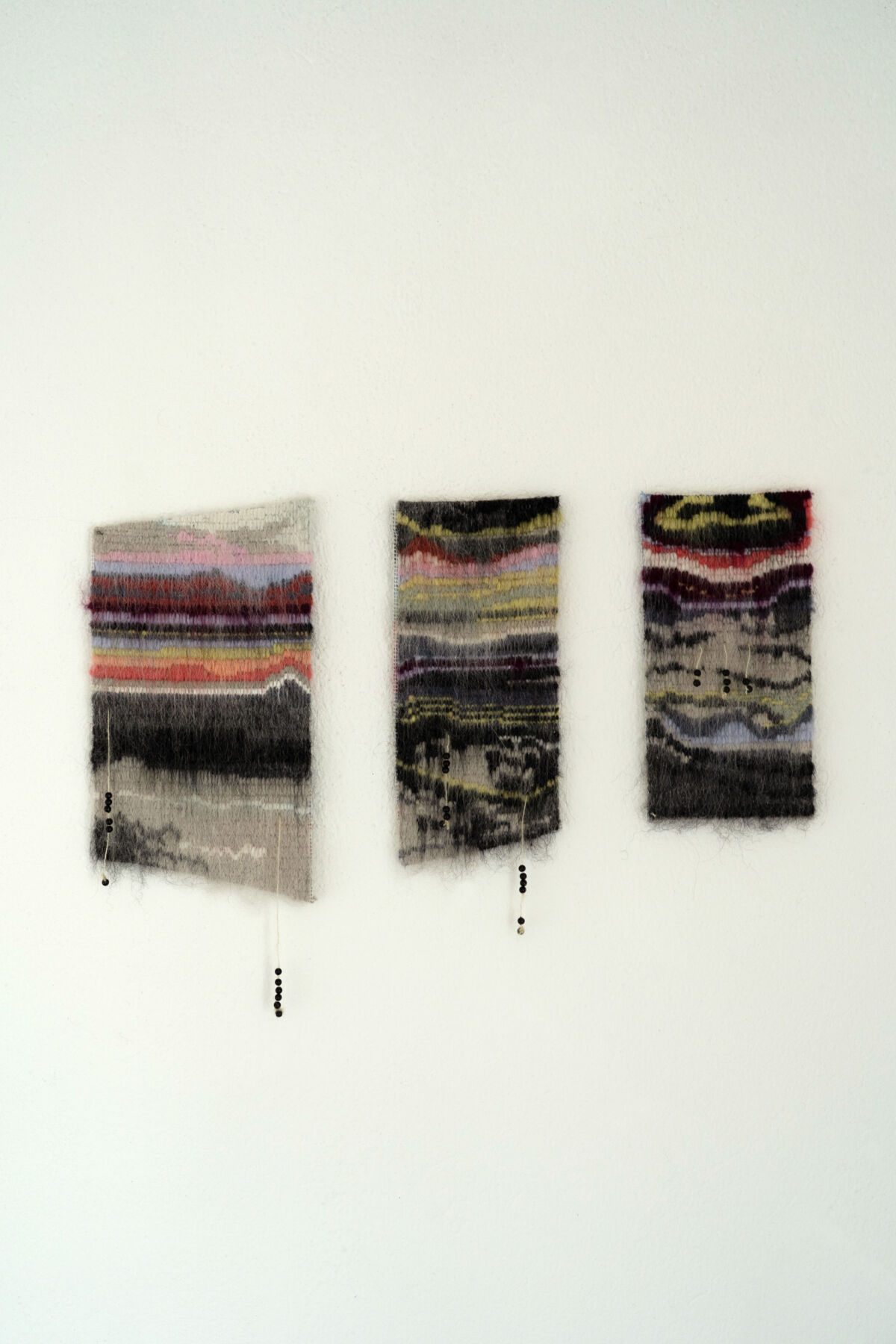
Working together makes us feel very powerful — getting girls together to take up space is sometimes much easier than alone. I also feel powerful on my own, painting walls, but it gets another spice when women get together and create, especially in a field like urban art, which is still very male-dominated.
You took part in the Female Street Art Incubator Camp — an educational residency for emerging female street artists, held in Čačak this spring. What were the most valuable parts of that experience for you?
– The camp showed me again how important community is. Being together, exchanging, talking, and having mentoring was the most valuable part for me.
You’re coming to FASADA Festival as one of the winners of the Female Rising Star Award, given to four participants of the Female Street Art Incubator Camp, where you developed the concept for your mural. Can you tell us more about the piece you’ll be painting in Sarajevo?
– My mural is about the feeling of warm summer days in the countryside — enjoying the silence, listening to the crickets in the high grass, sitting in the shade, warm wind on your skin. It is about respecting our environment and living in peace with each other. Those are the feelings I had during the camp, which took place in the countryside close to Čačak.
How do you see the future of public space? What do you hope your art contributes to that future?
– Public space should be for everyone. I don’t only want to make a place prettier through mural painting, but also more accessible. Our world gets more digital and politically divided, which isolates us from each other. That is why it is important that there are places outside where people can meet and talk, no matter if you know each other or not. We have to stay united and try to understand each other, rather than staring at our screens and talking to AI. If cities support urban art — or art in general — more, I think it’s more likely it will bring people together, because it creates space.
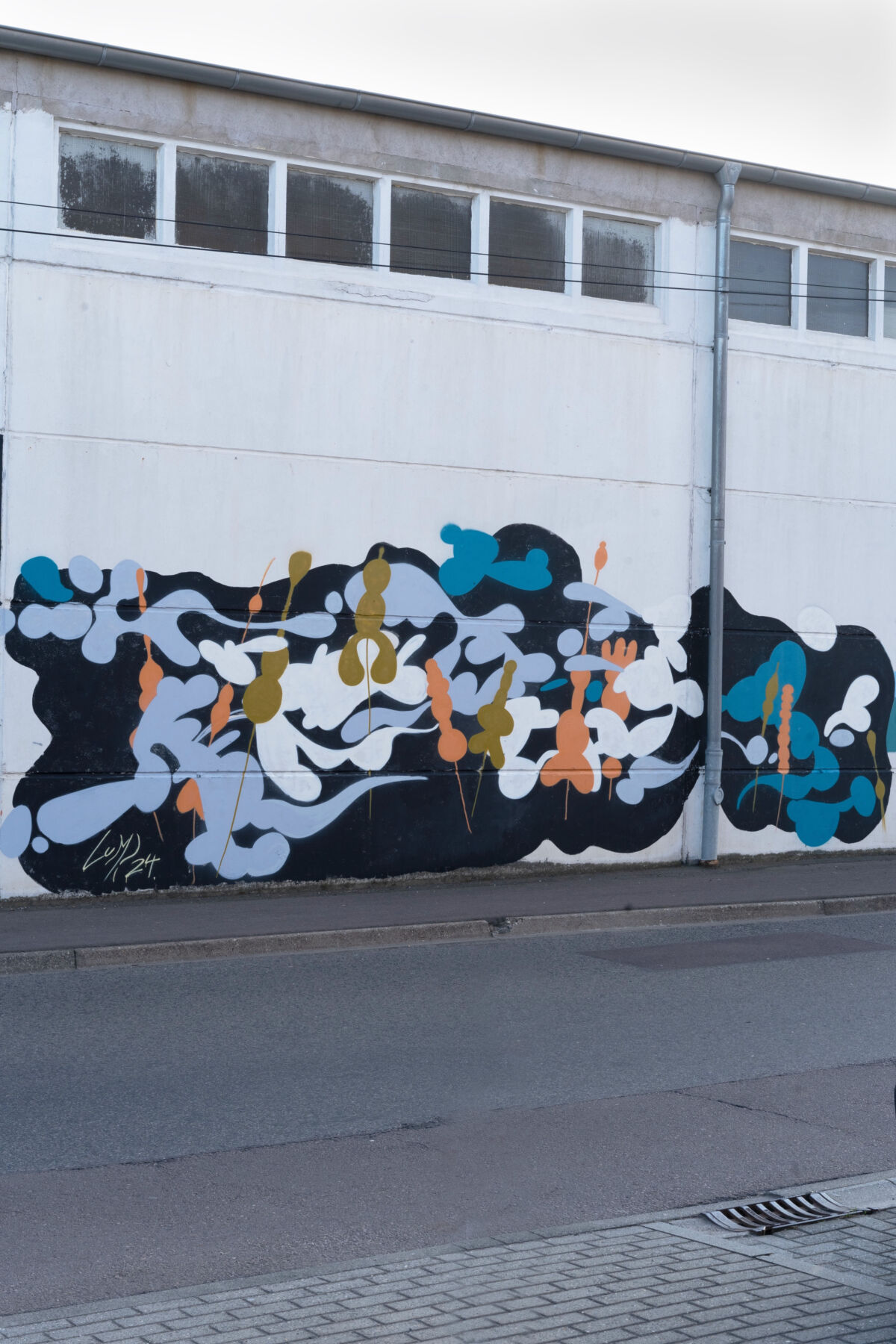
Our world gets more digital and politically divided, which isolates us from each other. That is why it is important that there are places outside where people can meet and talk, no matter if you know each other or not. We have to stay united and try to understand each other, rather than staring at our screens and talking to AI. If cities support urban art — or art in general — more, I think it’s more likely it will bring people together, because it creates space.
Is there a mural, installation, or project you’d still like to bring to life?
– At the moment I am concentrating on working with textiles. I do embroidery and weaving. With those, you can go large-scale, and I would like to include that more in installations. Last year I started to paint on big fabric pieces, which was kind of the start of that journey.
Do you have any expectations of Sarajevo?
– Learning more about Balkan culture, meeting people, and just painting!
Uređivačka transparentnost:
Ovaj članak je pripremljen u skladu sa Uređivačkim smjernicama FBL magazina. Naša misija je osigurati tačnost, integritet i estetsku vrijednost svake objavljene informacije. Primijetili ste grešku ili želite uputiti ispravku? Javite nam se ovdje.
Sadržaj je autorsko vlasništvo FBL Creative, Mannheim.